

42,900 OpenClaw Exposed Control Panels and Why You Should Care
Venu RaoFebruary 12, 2026
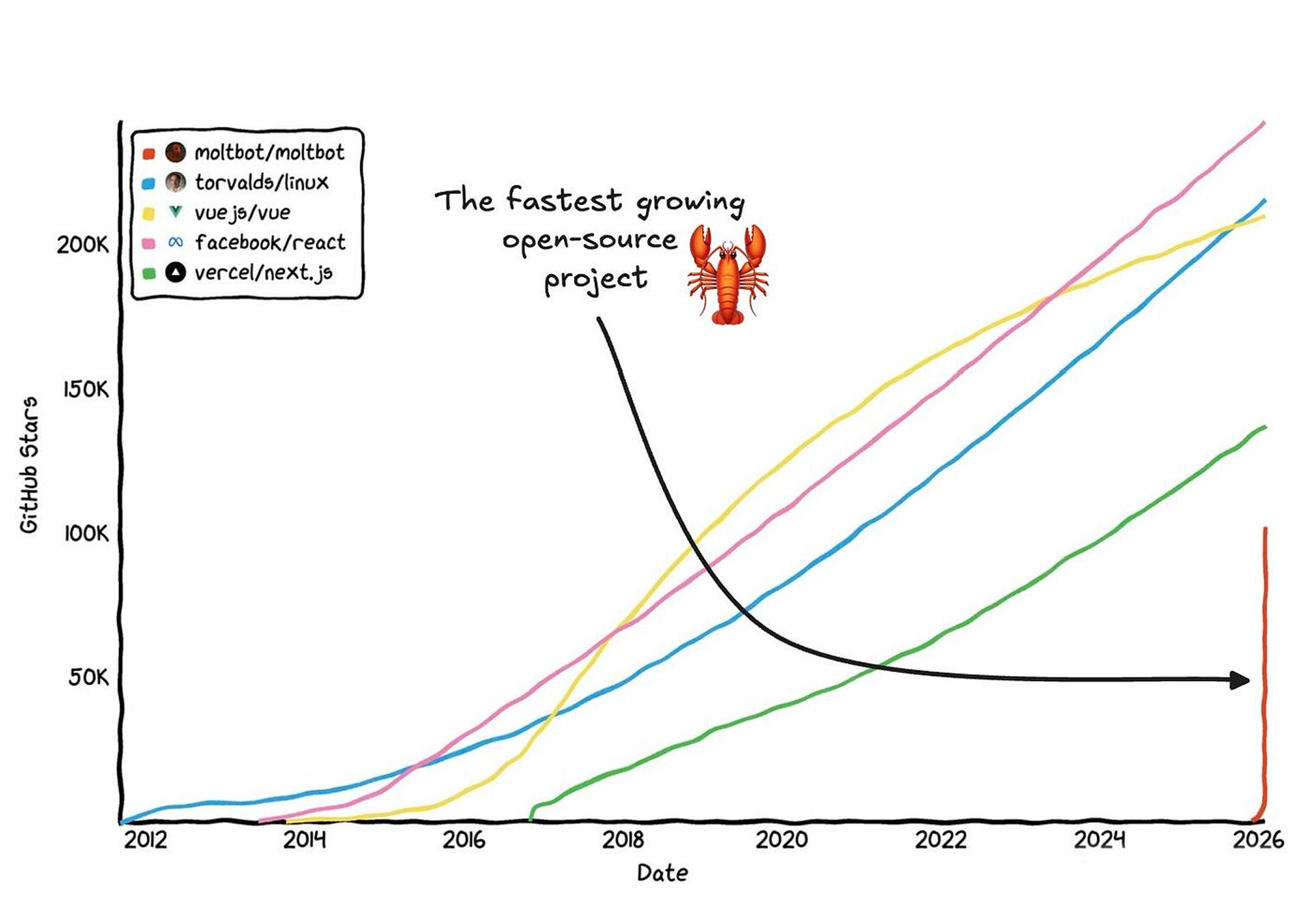
Over the past two weeks, most coverage around Moltbot and OpenClaw has chased the flashy angle. One-click exploits, remote code execution, APT chatter, scary screenshots. Meanwhile, security teams are doing what they always do when a new tool gets hit. Patch, block ports, rotate keys.
That's necessary, but it's not the main story.
 If you have been scrolling through OpenClaw headlines and wondering what the real risk is, here is the simple version.
Clawdbot, later renamed Moltbot and then OpenClaw, is an AI agent that acts on your behalf. You connect it to your email, Slack, files, and browser. It sends messages. Schedules meetings. Pulls data. Executes commands. It operates inside your digital workspace using your permissions.
The capability is not the issue. The architecture is.
The convenience comes with costs -
If you have been scrolling through OpenClaw headlines and wondering what the real risk is, here is the simple version.
Clawdbot, later renamed Moltbot and then OpenClaw, is an AI agent that acts on your behalf. You connect it to your email, Slack, files, and browser. It sends messages. Schedules meetings. Pulls data. Executes commands. It operates inside your digital workspace using your permissions.
The capability is not the issue. The architecture is.
The convenience comes with costs -
The UI accepts a gatewayUrl parameter, and on load, it can connect out and leak a stored auth token over a WebSocket flow. A single click can be enough to hand an attacker authenticated access.
Why this is the one to focus on:
OpenClaw-style deployments often store credentials in local directories, commonly in plaintext, and sometimes in backup files that keep old versions around.
"Deleted" tokens still exist on disk. Token rotation is less effective if old copies remain accessible. Commodity infostealers can harvest these directories without touching the agent.
AI is Scaling Faster Than Your Control Model
AI is expanding faster than security teams can adapt. Not just in tech companies. Everywhere. Your marketing team, your sales team, your HR department, and even your finance analysts. Everyone's rushing to deploy AI agents because, finally, there is a technology that doesn't require a computer science degree. No coding. No complex setup. Just chat with it and watch it work. OpenClaw exploded because it promised exactly that. Non-technical users could automate their grunt work in minutes. Connect your email, Slack, files, browser, and let the agent handle scheduling, research, data gathering, and even sending messages on your behalf. Within weeks of going viral, 42,900 exposed control panels appeared across 82 countries. In a world where AI was supposed to make everything easier, we've made it exponentially easier to get compromised. These tools have real caveats. They're credential-heavy because they need access to everything they automate. They're broadly permissioned because they act with your full user privileges. They store secrets insecurely, often in plaintext local directories. But security is taking a back seat because now the entire value proposition is speed and ease. The friction that security introduces (approvals, reviews, configuration hardening, access policies) directly contradicts why people adopted the tool in the first place. This is why cybersecurity will never run out of jobs.What All the Noise is Actually About
If you have been scrolling through OpenClaw headlines and wondering what the real risk is, here is the simple version.
Clawdbot, later renamed Moltbot and then OpenClaw, is an AI agent that acts on your behalf. You connect it to your email, Slack, files, and browser. It sends messages. Schedules meetings. Pulls data. Executes commands. It operates inside your digital workspace using your permissions.
The capability is not the issue. The architecture is.
The convenience comes with costs -
- It stores credentials locally, often in plaintext directories.
- It runs with broad permissions across multiple services at the same time.
- It can be deployed in minutes without IT knowing it exists.
- It has known vulnerabilities that allow token theft and remote takeover.
- 78% of exposed instances remain unpatched weeks after fixes were released.
Why Your Security Model Was Not Built for This
The real issue is not the vulnerability cycle. It is that most enterprise security models were never designed for autonomous delegation. Traditional controls assume software enters through approved channels, runs on managed endpoints, and operates through centrally governed identities tied to human sessions. AI agents violate those assumptions.- They can be installed quietly.
- They authenticate with personal OAuth tokens and API keys outside IAM workflows.
- They operate continuously, not within human session boundaries.
- They act across multiple platforms at once.
- Most detection models are tuned for compromised users.
- Not compromised delegation.
- IAM tracks issued credentials.
- Not tokens accumulated by local automation.
- Asset inventories track servers and managed software.
- Not lightweight agents deployed in minutes by business teams.
- That is the structural shift.
How Widespread is the OpenClaw Exposed Control Panels Problem
Global Scale and Distribution
Most exposed instances are in the United States. China accounts for 37% of the total, making it the second-largest deployment base. Singapore shows up as the third-largest cluster. The geographic spread matters less than where they're hosted. About 45% sit on Alibaba Cloud infrastructure. Another significant chunk runs across Tencent Cloud, DigitalOcean, and Hetzner. Roughly 10% hide behind Cloudflare proxies, which suggests either someone knew enough to worry about DDoS protection, or they copied a template from someone who did. The clustering around specific cloud providers tells you something important. Insecure deployment templates are being reused at scale. When one misconfigured setup gets copied across hundreds of instances, the attack surface does not just grow. It multiplies. The clustering around specific cloud providers suggests that insecure deployment templates are being reused at scale. When one misconfigured setup gets copied across hundreds of instances, the attack surface does not just grow. It multiplies.The Version Fragmentation Problem
The exposed control panels showed:- 39.5% still labeled “Clawdbot Control” (original branding)
- 38.5% labeled “Moltbot Control” (January 27 rebrand)
- 22% using the current “OpenClaw Control” branding (January 29 to 30 rebrand)
The Breach Correlation Signal
About 53,300 of these exposed instances sit on infrastructure that's shown up in breach records before. That's roughly 33.8% of exposed infrastructure showing correlation with known threat actor activity, including Kimsuky, APT28 (Fancy Bear), and other groups engaged in reconnaissance and exploitation. This does not automatically mean those groups are operating the agents. It means the infrastructure has an overlap with known adversary activity. Either attackers are deploying agents on compromised systems, or agents are being deployed on infrastructure that has already been exposed or abused. Either way, there's no governance here.The Vulnerabilities that Turned This Into an Incident Cycle
Several published OpenClaw vulnerabilities created a rapid patch-and-exploit loop. The one CISOs should care about most is the one that breaks the usual “we bound it to localhost, so we are safe” assumption.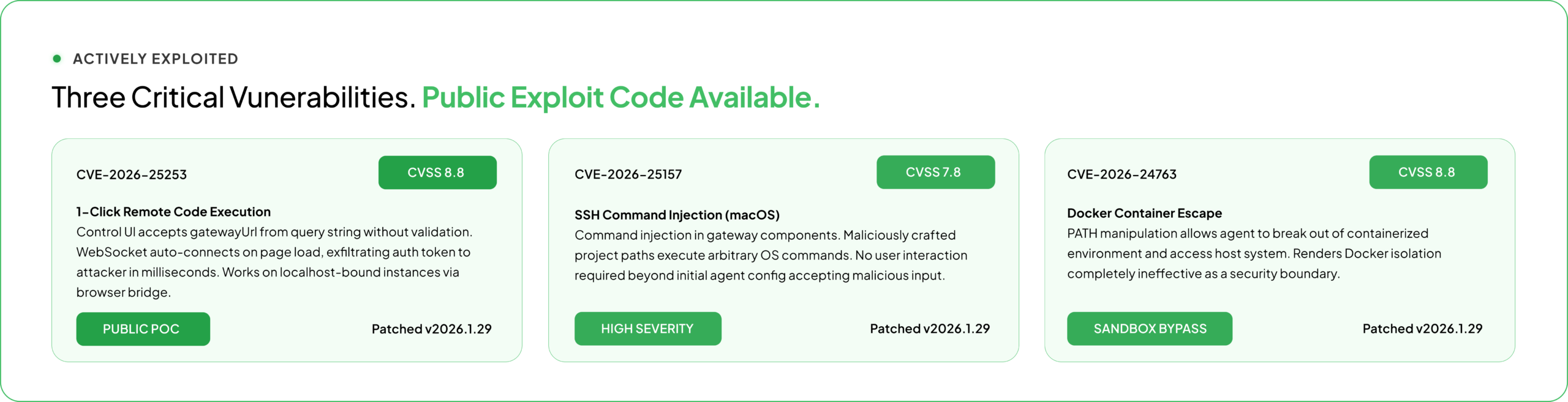 CVE-2026-25253: One-click token theft leading to takeover
The UI accepts a gatewayUrl parameter, and on load, it can connect out and leak a stored auth token over a WebSocket flow. A single click can be enough to hand an attacker authenticated access.
Why this is the one to focus on:
- It can work even when the service is not publicly exposed, because the browser becomes the bridge.
- The outcome is not “a bug.” The outcome is a stolen token, then agent takeover, then host-level actions.
CVE-2026-25157: Command injection path on macOS
A gateway input handling flaw can allow crafted input to reach OS command execution in macOS contexts. The business impact is what matters: developer workstations are high-value because they often hold repo access, cloud tooling, and keys.CVE-2026-24763: Container escape risk
Containerization is often treated as a safety boundary for risky automation. A container escape issue erodes that boundary and turns “sandboxed agent” into “host agent” when exploited. Patch timing matters here. If a majority of exposed instances are still running older versions weeks after fixes are released, attackers do not need to be creative. They only need patience and scanning.What Attackers Get When They Break In
 The credentials problem is bigger than the agent itself
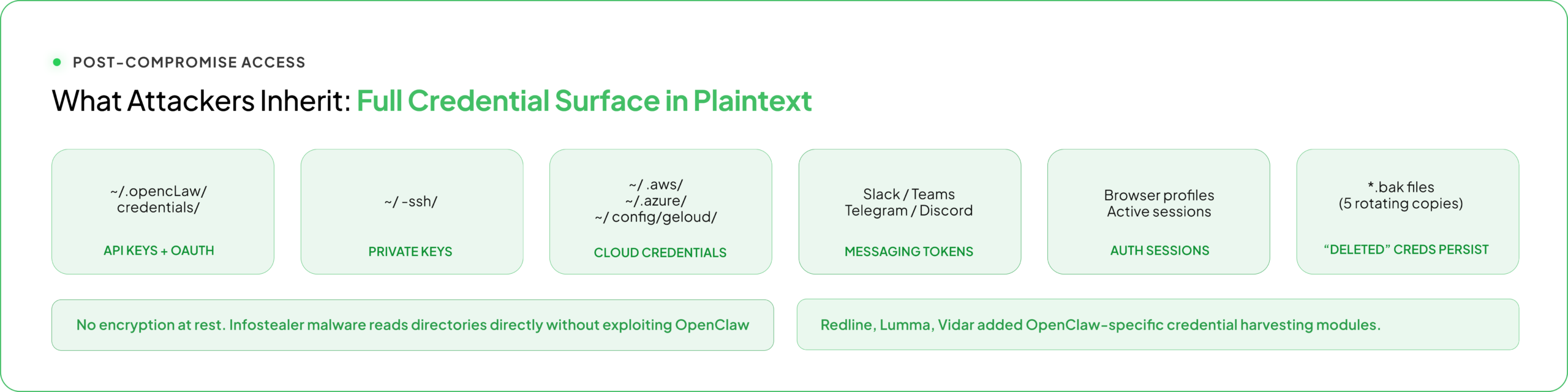
OpenClaw-style deployments often store credentials in local directories, commonly in plaintext, and sometimes in backup files that keep old versions around.
"Deleted" tokens still exist on disk. Token rotation is less effective if old copies remain accessible. Commodity infostealers can harvest these directories without touching the agent.
The developer workstation multiplier
If the compromised agent sits on a workstation, it's not just a single host incident. It becomes:- SSH access expansion through local keys and configs
- Cloud access expansion through CLI credentials and kube configs
- Lateral movement through chat impersonation and trusted internal channels
- Data access through already-authenticated browser sessions
The "trusted identity" masking effect
When attackers operate through an agent tied to a legitimate user's tokens, activity looks like authorized automation. This complicates triage because logs show valid sessions, valid OAuth flows, and normal SaaS APIs. This issue is not only about OpenClaw. It is about what happens when autonomous automation becomes common before security programs have a control model for it.Why This Matters for Organizations
This issue isn't only about OpenClaw. It's about what happens when autonomous automation becomes common before security programs have a control model for it. Business impact shows up fast: Higher blast radius per compromise because one agent links multiple services. Harder incident containment because you must revoke and rotate many tokens across many platforms. More credible internal social engineering because attackers can speak through trusted chat identities. Audit and compliance friction because you can't prove where tokens live or how access is governed. If your program gets measured on "reducing exposure," this is exposure in its clearest form: privileged automation running outside oversight.What to Do Now
Start with the obvious:- Scan your IP ranges for OpenClaw, Moltbot, and Clawdbot signatures using Shodan or Censys
- Look for port 18789, favicon hashes, and the three HTML title patterns
- If you find instances, update to version 2026.1.29 or later immediately
- Bind the gateway to 127.0.0.1 and set strong authentication passwords
- Rotate every credential the agent touched (SSH keys, API keys, cloud credentials, OAuth tokens)
- Manually purge .bak backup files where "deleted" credentials persist
- Treat AI agents as privileged non-human identities
- Add agent detection to your endpoint monitoring
- Scan for credential directories (~/.openclaw/, ~/.clawdbot/, ~/.moltbot/)
- Monitor for process patterns that indicate autonomous agent operation
- Work with your security vendors to develop agent-specific detection capabilities
- Segment agent access aggressively (no agent should have simultaneous access to email, Slack, file storage, and production databases)
- Log agent actions, not just user authentication
- Update incident response playbooks to include agent compromise scenarios
- Establish a clear policy on AI agent usage before the next viral tool drops