

Security teams are facing exposure patterns that form and spread far faster than traditional assessment cycles can handle. A misconfigured cloud role created during an early-morning deployment can expose sensitive permissions before lunch. A forgotten internet-exposed asset can be scanned by automated bots within minutes. These examples highlight a reality that many teams acknowledge but struggle to address: exposures move faster than security programs built on periodic checks.
At the same time, a surprising proportion of exploited weaknesses are not new at all. Many attacks leverage issues that have existed for years, sitting unnoticed inside massive backlogs. These unresolved findings are often lost amid countless low-priority results produced by scanners. When environments change frequently, backlogs grow in size, relevance drops, and critical issues stay buried for too long.
This combination of a fast-changing operational environment paired with large volumes of unresolved legacy issues creates an exposure gap that older control models cannot handle. That is why Continuous Threat Exposure Management, or CTEM, has become a core strategy for modern security programs. CTEM adapts to the speed at which environments evolve. It introduces continuous discovery, continuous validation, and continuous routing of issues, replacing reactive cycles with ongoing operational oversight.
The shift toward CTEM is not driven by theory. It is driven by operational pressure, technology change, and measurable exposure failures.
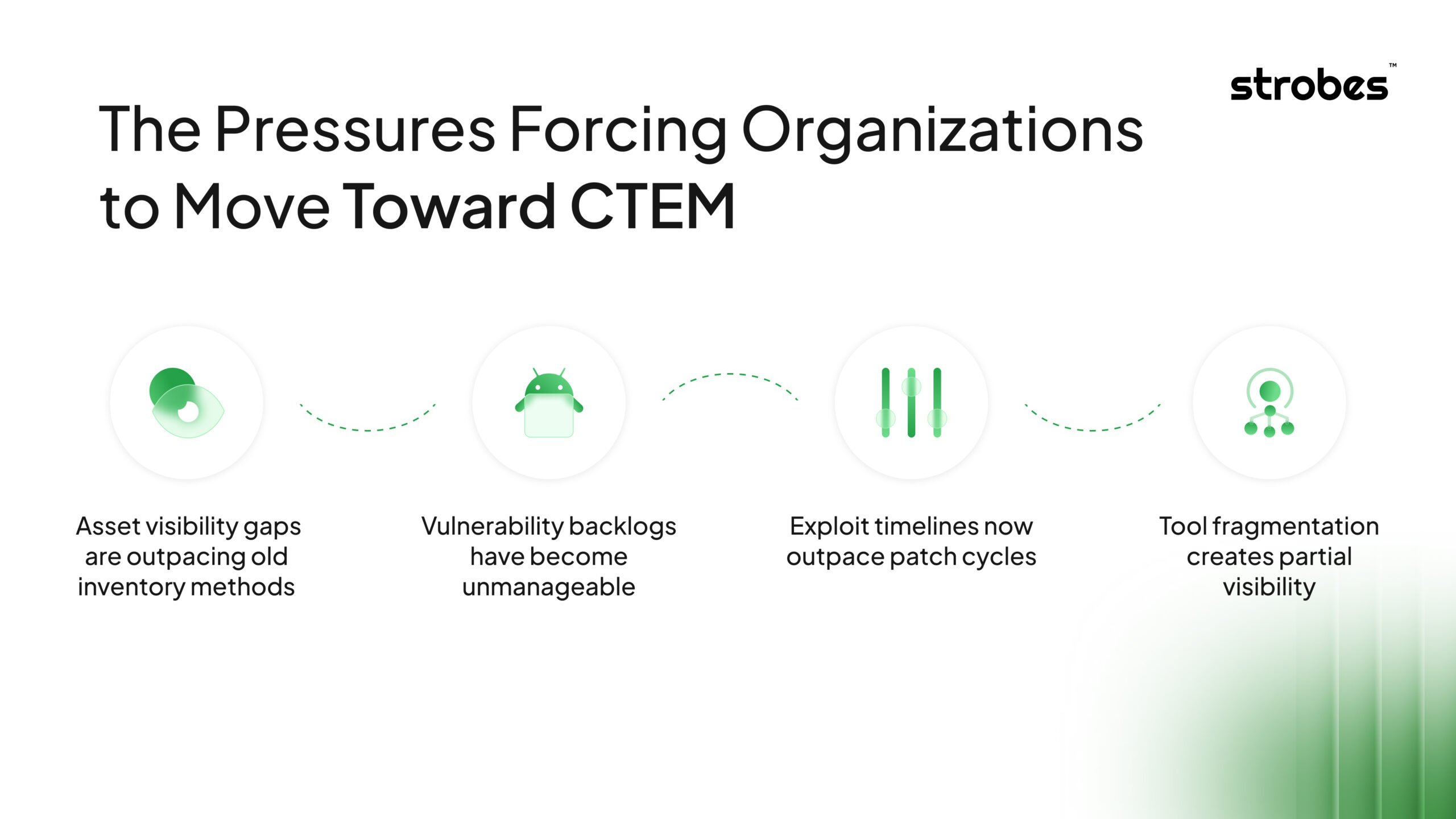
The Pressures Forcing Organizations to Move Toward CTEM
1. Asset visibility gaps are outpacing old inventory methods
Traditional asset inventories were created for environments where systems were stable and predictable. Those assumptions no longer hold. Cloud adoption, container orchestration, short-lived workloads, and widespread SaaS usage have created layers of assets that appear, modify themselves, move, or disappear within hours. Examples include:- Kubernetes pods that spin up for only minutes
- Shadow SaaS applications installed without security oversight
- Test environments deployed by engineering teams without asset registration
- Automated pipelines that generate or modify cloud resources dynamically
2. Vulnerability backlogs have become unmanageable
In many enterprises, security teams face backlogs in the tens of thousands. Some large organizations even report 100,000+ unresolved findings accumulated over years. Yet engineering teams do not have the bandwidth to address everything. The challenge is not the number of vulnerabilities. The challenge is identifying which ones genuinely matter. Traditional models treat all scanner findings as equal, pushing them into ticket queues with little filtering. Engineering teams, already managing product deadlines, are forced to triage manually. This leads to:- High frustration
- Lost time
- Poor alignment between security and engineering
- Critical issues buried under noise
3. Exploit timelines now outpace patch cycles
Public exploit code often appears within hours of a vulnerability being announced. This rapid turnaround shrinks the remediation window dramatically. Quarterly, monthly, or even weekly scans cannot keep up because they rely on scheduled assessments rather than real-time checks. This challenge is made worse by:- Automated exploit kits
- Continuous scanning tools used by attackers
- High-value attack surfaces like cloud identities or exposed APIs
- Delay between security discovery and engineering action
4. Tool fragmentation creates partial visibility
Most security programs rely on a wide collection of tools. Each tool is strong in its area, but none of them offer a complete view when used in isolation. Over time, this creates inconsistent insights, duplicated work, and blind spots. Organizations often use:- External asset scanners to map internet-facing systems.
- Internal vulnerability scanners to check servers, endpoints, and networks.
- Container security tools to inspect images, registries, and running containers.
- Identity configuration analyzers to detect issues with privileges, roles, and misuse of access.
- Code review tools to find weaknesses during development.
- Cloud configuration scanners to analyze cloud infrastructure, storage settings, excessive permissions, and service misconfigurations.
- Pentesting reports that uncover logic flaws, privilege jumps, chained attack paths, and misconfigurations that scanners cannot detect.
Why is this fragmentation a serious problem
Because these tools do not communicate with each other, organizations face several challenges.1. Accuracy drops
When tools do not correlate their findings:- A cloud misconfiguration may link directly to an exploitable vulnerability, but the connection stays invisible.
- A high-severity scanner result might not matter because the asset is offline, decommissioned, or low-value.
- Identity issues may enable attacker movement, but the related host or container finding is treated separately.
2. Prioritization becomes unreliable
Without a unified context, prioritization often depends on raw scanner severity rather than real risk. Example: A medium-severity finding on a payment system with broad access is far more dangerous than a critical vulnerability on a test server. Fragmented tools cannot make this distinction. CTEM solves this by linking issues to asset value, identity reach, exploitability, and exposure level.3. Visibility breaks down
Each tool covers only a part of the environment. Fragmentation leads to:- Duplicate assets
- Missing assets
- Conflicting configuration insights
- Multiple interpretations of the same issue
- Difficulty spotting attack paths across different layers
4. Reporting becomes inconsistent
When leadership asks for exposure status, analysts spend hours manually merging:- CSVs
- Tool dashboards
- Cloud logs
- DevOps outputs
- Pentest PDFs
What CTEM Provides That Traditional Approaches Cannot
I. Continuous discovery across all environments
Traditional inventories were built for environments where assets changed slowly. Servers stayed online for years, applications had predictable update cycles, and new systems were added only through formal IT processes. That approach no longer works. Modern environments change constantly due to automation, cloud-native architectures, and decentralized development practices. This is why CTEM shifts from static inventories to continuous discovery. Instead of capturing assets at a single point in time, CTEM keeps monitoring the environment every day, every hour, or even every few minutes, depending on the setup.1. Cloud Workloads
Cloud platforms generate new assets automatically:- Auto-scaling groups create and remove servers based on demand
- Developers launch temporary test environments
- CI/CD pipelines deploy new services on every commit
- Functions and serverless components appear during runtime
2. SaaS Platforms
Teams now rely on cloud-based software for almost every function. These tools are easy to access, often require no installation, and can be purchased or activated by anyone with a corporate email. This speed creates a situation where new applications appear across the organization faster than central IT or security can register or review them.Examples of SaaS tools are often adopted without oversight
1. File-sharing services
Employees use these to send large documents or collaborate with external partners. If used without controls, sensitive data may move into environments that security cannot monitor.2. CRM and marketing tools
These typically store customer information, campaign data, and analytics. When added without review, they may introduce exposure through weak configurations, poor access control, or unmonitored integrations.3. Productivity apps
Note-taking apps, task managers, screen recorders, and personal assistant tools often connect to corporate email and file systems. Each connection can reveal more information than intended.4. Collaboration platforms
Tools for chat, meetings, whiteboarding, or project work may allow file uploads, link sharing, and third-party integrations. Without oversight, these channels can become unseen pathways for data movement.Each SaaS tool introduces additional exposure points
1. Identity integrations
Most SaaS tools connect through single sign-on or OAuth. If configured poorly, they may grant more permissions than necessary or leave unused accounts active.2. Data-sharing connections
Many tools sync files, contacts, calendars, or documents with other platforms. These connections can move data outside approved boundaries.3. Access permissions
Users may receive broad rights such as admin-level access without realizing the impact. Over-permissioning remains one of the most common sources of exposure in SaaS environments.4. Third-party risk
Every SaaS vendor has its own security posture. When teams adopt tools without review, organizations inherit the risk of that vendor's controls, policies, and infrastructure. CTEM continuously identifies SaaS usage so security teams are no longer surprised by shadow applications.3. Identities and Privileges
Identity systems change frequently because employees join, leave, switch roles, or gain elevated access temporarily. Identity drift leads to:- Orphaned accounts
- Excessive privileges
- Misconfigured IAM roles
- Forgotten service accounts
- Over-permissioned cloud access
4. Containers and Orchestrations
Containers are short-lived and highly dynamic. Orchestration tools like Kubernetes automatically:- Spin up pods
- Move workloads across nodes
- Replace containers during rolling updates
- Pull new images from registries
5. APIs
APIs multiply rapidly across microservices. New endpoints appear during deployments, version upgrades, or integrations. API-related risks include:- Unauthenticated endpoints
- Weak authorization checks
- Overexposed data fields
- Deprecated routes left online
6. External Assets
Internet-facing systems remain one of the most targeted entry points for attackers. External environments change when:- DNS entries are updated
- Subdomains are created
- Marketing teams launch new microsites
- Dev teams expose testing tools accidentally
- Old assets are decommissioned incorrectly
Validation that confirms what is exploitable
Validation distinguishes CTEM from older models. Instead of treating every scanner result as a threat, CTEM evaluates issues through:- Automated exploit attempts
- Attack-path calculations
- Lateral movement simulations
- Privilege escalation checks
- Exposure reach analysis
Prioritization grounded in real impact
CTEM uses real-world factors to prioritize exposures. These include:- How easily an attacker can reach the asset
- Whether a public exploit exists
- Whether the asset holds sensitive data
- How privileged the associated identity is
- Whether the issue connects to a larger attack path
II. Built-in remediation workflows with clear ownership
Even validated and prioritized issues fail if no one owns them.1. Ownership assignment
Every exposure must be tied to the right team from the start. CTEM assigns responsibility based on asset type, service owner, or environment, removing guesswork. This prevents delays caused by unclear accountability.2. SLA tracking
Once an issue is assigned, CTEM keeps track of the expected fix timeline. Teams can see how long they have to resolve an exposure, and leaders get visibility into which groups meet their commitments and which ones require support.3. Fix verification
Applying a fix is not enough unless it is confirmed. CTEM automatically re-checks the asset to validate that the exposure is fully resolved. This eliminates reliance on manual confirmation and prevents false assumptions of closure.4. Routing to the correct team
Different issues belong to different owners. A cloud misconfiguration may go to the cloud team, while a code flaw goes to the application team. CTEM routes each exposure to the appropriate group so remediation does not stall due to misdirected tasks.5. Automated reminders
If an issue is approaching an SLA deadline or has been idle for too long, automated reminders notify the assigned team. This ensures exposures do not get buried or forgotten in busy engineering cycles.6. Handoff tracking between security and engineering
CTEM records every transition in the workflow, showing when security created the issue, when engineering accepted it, and when the fix was validated. This avoids confusion, reduces miscommunication, and helps both teams understand exactly where the task stands. The entire flow from discovery to validation to remediation runs as one loop. This loop repeats continuously, ensuring exposures do not sit unresolved.Why Every Security Persona Feels the Pull Toward CTEM
A modern security program only works when every team sees value in the process. CTEM makes this possible. By reducing noise, improving clarity, and creating a predictable operational cycle, CTEM supports each group in a way that feels practical and immediately beneficial.Security Engineers
Security engineers deal with overwhelming amounts of data every day. CTEM finally trims that down. Instead of sifting through long lists of scanner results, they receive cleaner, validated information with the context needed to act quickly. Investigations become smoother because findings are linked to clear asset details, identity reach, and exposure impact. This means less time wasted on dead-end analysis and more time spent solving problems. Example: A scanner flags 2,400 “critical” findings on a set of cloud hosts. CTEM validation shows that only 18 of them are actually reachable and exploitable. Engineers avoid spending days filtering useless alerts and can focus directly on the 18 real risks.AppSec Teams
Application security teams work across code, APIs, cloud services, and internal systems. CTEM gives them a unified view that connects these layers. When exposures are identified early in development cycles and validated before reaching AppSec, the workload shifts from reactive firefighting to proactive guidance. Teams can focus on meaningful issues rather than sorting through noise created by multiple scanners and tools. Example: CTEM detects a high-risk API weakness and connects it to an exposed cloud role and a weak container configuration that were identified by separate scanners. AppSec finally sees the full chain instead of isolated issues coming from multiple tools.Cloud and DevOps Teams
Cloud and DevOps teams often face friction when security sends a long list of unclear or low-value tickets. CTEM helps remove that tension. It detects configuration drift immediately and ensures that only confirmed, relevant issues reach DevOps. This reduces interruptions and prevents unnecessary work during fast-paced release cycles. As a result, Cloud and DevOps teams experience smoother collaboration with security and maintain higher deployment speed without compromising safety. Example: A developer temporarily grants admin-level rights to a test role during a release and forgets to remove it. CTEM catches the drift within minutes, alerts the cloud team, and prevents the role from remaining over-permissioned for days.Security Managers
For managers, CTEM offers clear visibility into how exposure levels change over time. They can see where bottlenecks appear, which teams are meeting SLAs, and which areas require extra support. The availability of measurable metrics also makes reporting easier. Instead of manually assembling insights from multiple tools, managers rely on a consistent set of exposure-focused indicators that show real progress. Example: A manager sees that 60 percent of overdue SLA tasks come from the database team. This tells them exactly where extra staffing or tooling support is required, instead of assuming the delays are spread across the organization.CIOs
CIOs look for ways to strengthen operational reliability while keeping technology teams efficient. CTEM supports this goal by highlighting risk in a manner that blends technical detail with business relevance. It shows which systems carry the most exposure, how quickly issues are being resolved, and where improvements are needed. CTEM also enhances collaboration across engineering, cloud, AppSec, and security teams, allowing CIOs to manage the entire IT ecosystem with better clarity and coordination. Example: A CIO notices through CTEM that misconfigurations in a new cloud region appear frequently due to rushed deployments. This insight helps the CIO enforce a stable rollout process and improve collaboration between DevOps, cloud, and security teams.CISOs
CISOs need accurate insight into whether the organization’s risk posture is improving. CTEM gives them validated, trustworthy inputs instead of raw scanner numbers. Because findings are verified before they reach dashboards, CISOs gain real confidence in exposure trends. CTEM also provides structured evidence for audits, regulatory assessments, and board discussions. This reduces uncertainty, supports stronger risk communication, and helps CISOs demonstrate progress with precision. Example: During an audit, a CISO can show the exact number of validated exposures resolved in the last quarter, the time taken to fix each one, and the proof of verification. This eliminates last-minute manual report creation and reduces audit pressure.CFOs
CFOs evaluate security investments through the lens of cost efficiency and business protection. CTEM contributes to both. By reducing noise, it saves engineering hours that would otherwise be spent sorting and triaging large volumes of irrelevant findings. It also lowers the probability of costly incidents by addressing exposures earlier and more accurately. These improvements give CFOs a clear understanding of how each security dollar reduces operational and financial risk. Example: Before CTEM, engineering teams spent nearly 200 hours each month sorting through irrelevant scanner alerts. After CTEM validation and filtering, that effort drops to fewer than 40 hours. The CFO can directly map this improvement to reduced operational cost.Business and Technical Forces Accelerating CTEM Adoption
Cloud-scale change drives constant configuration drift
Modern cloud environments experience continuous modifications, many automated through CI/CD pipelines. Every change can introduce or remove exposures. Traditional security reviews are too slow to catch these shifts. CTEM works with this operational reality. It checks environments continuously so configuration drift does not turn into an undetected weakness.Regulatory scrutiny is increasing
Compliance frameworks such as SOC 2, ISO 27001, NIST guidelines, HIPAA, PCI DSS, and sector-specific mandates expect ongoing oversight. Periodic checks are no longer considered adequate. Auditors now ask for:- Real-time monitoring evidence
- Proof of active oversight
- Measurable remediation patterns
- SLA compliance data
Business leadership wants quantifiable risk reduction
Leaders have grown tired of raw vulnerability counts. They prefer metrics tied to actual risk change. CTEM supports this by producing exposure-focused measurements that show:- Which exposures were validated
- How fast were they resolved
- How many assets became visible through continuous discovery
- How much noise was removed
Tangible Outcomes Organizations See After Implementing CTEM
Exposure windows shrink significantly
Because CTEM works continuously, teams fix issues faster. Validated, high-impact exposures often get resolved within hours or days instead of weeks.Backlogs become smaller and more meaningful
After validation removes noise, backlogs shrink dramatically. Only issues with genuine risk remain, and teams can manage them with far higher confidence.Visibility improves across environments
CTEM reduces unknown assets and unmanaged systems by continuously discovering them. This improves coverage across cloud, application, and on-prem environments.Role-specific metrics show clear improvement
1. MTTR (Mean Time to Remediate)
CTEM shortens the time it takes to address exposures. Since issues are validated and prioritized before reaching engineering, teams work on fewer but more meaningful items. This reduces delays and brings down the average time required to fix high-impact problems.2. SLA compliance
With clearer ownership, automated reminders, and accurate prioritization, teams are able to meet their deadlines more consistently. CTEM highlights overdue items early, helping managers take action before SLAs slip.3. High-risk asset count
As continuous discovery identifies new assets and validation removes noise, teams focus on what actually matters. Over time, the number of assets carrying confirmed high-impact exposures decreases because issues are addressed faster and tracked more accurately.4. Engineering effort saved from reduced noise
Because CTEM filters out non-exploitable or low-value findings, engineering teams no longer waste hours sorting through irrelevant tickets. This reduction in noise creates more available time for core product work and meaningful security fixes.5. Efficiency during audits
Auditors often ask for proof of monitoring, response timelines, and verification logs. CTEM maintains detailed records across the entire exposure cycle, so teams can provide accurate evidence quickly. This shortens audit preparation time and reduces back-and-forth clarification.6. Alignment between teams
Security, engineering, cloud, and DevOps teams operate with shared visibility and clearer expectations. Metrics give everyone a common understanding of progress and bottlenecks. This reduces friction and creates smoother collaboration across functions. These outcomes are measurable and trackable, which is essential for long-term programs.Conclusion
Organizations are moving toward CTEM because older assessment models no longer match how fast exposures appear or how complex environments have become. CTEM brings structure, speed, and clarity. It unifies discovery, validation, prioritization, and remediation into an operational loop that runs continuously. Teams gain visibility they can trust. Engineers receive fewer, more accurate tickets. Leaders receive metrics that reflect real exposure reduction. Auditors receive the evidence they expect during review cycles. CTEM has transitioned from being a forward-looking concept to becoming a necessary operational model for environments where change is constant and exposure windows must stay short. If you want to understand how CTEM can be implemented in a structured, practical manner and see how the model works in real environments, explore the Strobes platform. Visit the website to learn more or request a walkthrough tailored to your exposure challenges.TL;DR
Security teams are facing exposure patterns that form and spread far faster than traditional assessment cycles can handle. Tangible Outcomes Organizations See After Implementing CTEM Exposure windows shrink significantly Because CTEM works continuously, teams fix issues faster.
To understand the specific role agentic AI plays in closing the validation and mobilization gap in CTEM, read the unfiltered story behind Strobes AI and how a 5-person team can operate like a 50-person team.